

Written by Keisuke Unno — a graduate of Tokyo University of Foreign Studies (Persian Language).
Married to a non-Japanese partner, and host of the YouTube channel “Tabunka Gurashi 多文化ぐらし,” where he has interviewed dozens of international residents across Japan about their real lives here.

A Japanese rental contract (賃貸借契約書) is a dense document, often several pages of formal Japanese, and it’s common for foreign tenants to sign without fully understanding every clause. While you’re not expected to become a legal expert before renting, knowing which sections actually matter most can help you ask the right questions before you commit.
The Sections Worth Reading Closely
| Section | What to Check |
|---|---|
| 契約期間 (Contract period) | The lease term (2 years is common, but the actual period depends on the contract) and what happens when the contract ends or is renewed |
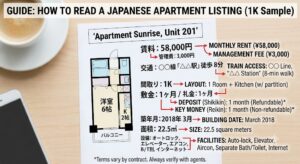
| 賃料・共益費 (Rent and management fee) | Confirm both figures separately — some listings advertise rent alone, with the management fee added on top |
| 敷金・礼金 (Deposit and key money) | The exact amounts and, for the deposit, any specific deduction clauses |
| 更新料 (Renewal fee) | Whether one applies, how much, and at what interval |
| 中途解約 (Early termination) | The required notice period (one month is common, but the actual period and any penalty depend on the contract) |
| 特約事項 (Special clauses) | Custom terms specific to this contract — this section is where unusual or property-specific obligations often appear, and it’s worth reading in full rather than skimming |
Special Clauses (特約事項): Why This Section Deserves Extra Attention
Standard lease templates cover the basics, but landlords can add custom clauses in the 特約事項 section that go beyond the standard terms — for example, a specific cleaning fee due at move-out regardless of the unit’s actual condition, restrictions on smoking or pets, or a shikibiki (敷引き) arrangement, where an agreed amount may be deducted from the deposit under the contract.
This type of arrangement is not universal and depends on the contract and property. Special clauses can have important consequences for your costs and responsibilities, so it’s worth reading this section carefully rather than assuming it’s boilerplate.
⚠️ Important Reminder: If a special clause isn’t clear to you, ask before signing. Once you’ve signed a contract, it can be difficult to challenge a clause simply because you later realized you misunderstood it. If you believe a clause is unclear, unusually burdensome, or potentially unfair, get advice before signing if possible.

Common Terms You’ll See
| Term | Meaning |
|---|---|
| 連帯保証人 (Rentai hoshounin) | Joint guarantor — a person, as opposed to a guarantor company, who agrees to be responsible for your obligations under the lease |
| 原状回復 (Genjou kaifuku) | Restoration to the original condition required under the rental agreement and applicable rules — tenants are generally not responsible for ordinary wear and tear |
| 禁止事項 (Kinshi jikou) | Prohibited actions — commonly includes things like subletting, keeping pets unless permitted, or certain renovations |
| 解約通知 (Kaiyaku tsuuchi) | Cancellation notice — the advance notice you’re required to give before moving out |
Before You Sign: 5 Questions to Ask
Even if you don’t understand every line of a Japanese rental contract, these questions can help you identify important costs and obligations before signing:
- What happens if I leave before the contract ends?
- How much notice do I need to give before moving out?
- Is there a renewal fee?
- Are there any fixed cleaning or restoration charges?
- Are there any special clauses that apply specifically to this property?
If You’re Not Confident Reading the Full Document
- Ask your agent to walk through the contract section by section verbally, even if the document itself isn’t translated
- Consider bringing a Japanese-speaking friend to the signing, or reviewing a photo of the contract with them beforehand
- Use a translation tool for a first-pass understanding, but treat it as a starting point rather than a substitute for asking questions about anything unclear — automated translations of legal Japanese can miss nuance
- For unusually complex situations, a one-time consultation with a specialist before signing is a reasonable step if something feels genuinely unclear

A Foreign Resident’s Experience
One foreign resident I spoke with was surprised by how detailed the special clauses in his rental contract were, particularly around cleaning fees and damage checks. His takeaway was simple: the 特約事項 section isn’t just boilerplate, and it’s worth reading in full rather than skimming past it.
FAQ
Q: Can I get an English translation of my contract?
A: This varies by agency — some foreign-friendly agencies provide an English summary or translation. If both Japanese and English versions are provided, check which version the contract specifies as controlling in case of a discrepancy.
Q: Are all special clauses (特約事項) legally enforceable?
A: Not automatically. Whether a particular special clause is enforceable can depend on its wording, the circumstances, and applicable law. If a clause seems unusually burdensome or unclear, consider discussing it with a qualified specialist before signing.
Q: What happens if I sign without fully understanding a clause?
A: Signing a contract generally means you agree to its terms, which is why it’s important to ask questions before signing. However, whether a particular clause is enforceable can depend on the wording, circumstances, and applicable law.
Your Contract-Reading Checklist
- Confirmed the exact contract period and renewal/cancellation terms
- Read the 特約事項 (special clauses) section in full, not just skimmed it
- Asked about anything unclear before signing, rather than after
- Confirmed the early termination notice period and any associated penalty
- Checked whether there are any fixed cleaning or restoration charges
- Kept a copy (photo or scan) of the signed contract for your own records
Stay Updated with ILSA Hub
Life in Japan comes with a lot of small questions — and the official ILSA Hub LINE account is where we help, especially with housing and everyday life.
- 🏠 Our Main Focus: Most of what we share is about housing and daily life in Japan — apartment hunting, contracts, and practical living tips.
- 💬 Ask Us Anything: Send us your questions about our articles, and we’ll help guide you using site-based information.
- ⏰ Never Miss a Deadline: Set an automated reminder right on LINE — just type “set reminder,” tell it what and when, and our system will notify you automatically as the date approaches (like 30 and 7 days before). Handy for things like visa renewals (up to 90 days’ notice) or lease renewal deadlines. Your dates are kept private and never shared outside ILSA Hub.
Scan or Click to Join:
👉 Tap Here to Add ILSA Hub on LINE

Disclaimer: ILSA Hub is an informational platform. We do not act as a licensed real estate agency, financial institution, medical provider, recruitment agency, or emergency service, and do not provide immigration, visa, or legal services. We are not a substitute for advice from a qualified administrative scrivener (行政書士) or attorney. We do not provide legal, medical, financial, or professional advice specific to your situation. Our responses on LINE are based solely on general guidelines provided on our website. For emergencies, always follow official government guidance.