
Written by Keisuke Unno — a graduate of Tokyo University of Foreign Studies (Persian Language).
Married to a non-Japanese partner, and host of the YouTube channel “Tabunka Gurashi 多文化ぐらし,” where he has interviewed dozens of international residents across Japan about their real lives here.
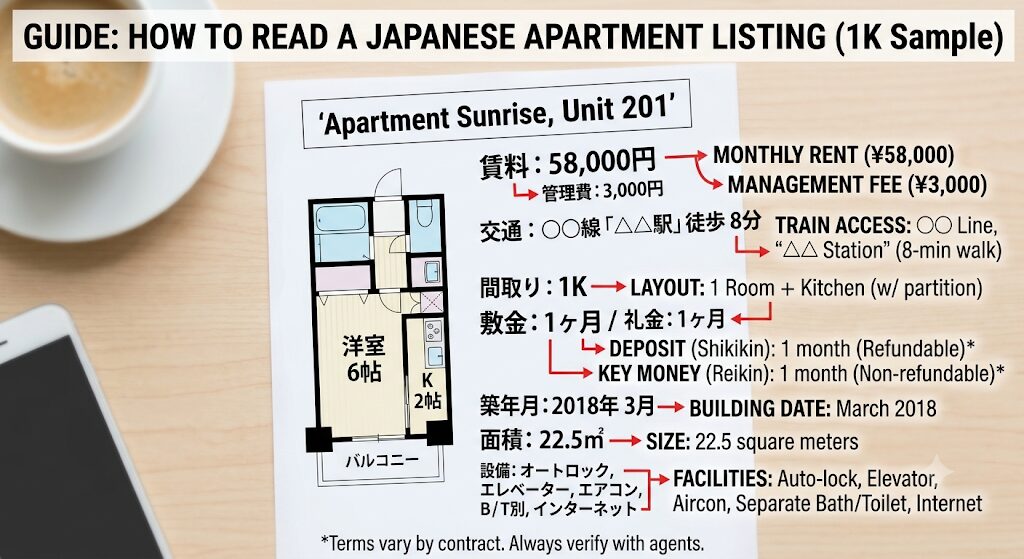
Japanese apartment listings pack an enormous amount of information into a tiny grid of numbers and letters — “1K,” “2LDK,” “徒歩5分,” “築15年” — and if nobody’s explained the shorthand, it’s easy to misjudge what you’re actually looking at.
Short answer: the number tells you how many rooms besides the kitchen/living area, and the letters (K, DK, LDK) tell you how that kitchen area is set up. Here’s how to read the rest of the listing with confidence.
Room Layout Codes: What the Letters Actually Mean
| Code | Meaning | Typical Size |
|---|---|---|
| 1R | One Room — the kitchen area isn’t separated from the living space at all | 13–20㎡ |
| 1K | One Room + Kitchen — a small, separated kitchen area | 15–25㎡ |
| 1DK | One Room + Dining Kitchen — a kitchen area large enough for a small dining table | 25–35㎡ |
| 1LDK | One Room + Living/Dining/Kitchen — a genuinely separate living room in addition to the bedroom | 35–45㎡ |
| 2LDK, 3LDK, etc. | The number indicates additional separate bedrooms beyond the LDK space | Varies |
Note: “1R” and “1K” are often confused by first-time renters. The practical difference is whether there’s a wall or partition between the kitchen and the room — 1K generally has one, 1R doesn’t.
Understanding “畳” (Jō): Japan’s Room-Size Unit
Alongside square meters, Japanese listings often describe individual room sizes using 畳 (jō) or 帖 (also read “jō”) — a unit based on the size of a traditional tatami mat. A room labeled “6畳” or “6帖” means it’s roughly the size of six tatami mats laid side by side. Short answer: for listing purposes, one jō is standardized at 1.62㎡ or more, regardless of the room’s actual style, so you can generally convert directly between the two units.
| Term | Typically Used For |
|---|---|
| 畳 (tatami / jō) | Traditional Japanese-style rooms (和室) with actual tatami mat flooring |
| 帖 (jō) | Western-style flooring rooms (洋室) and LDK space, where there’s no physical tatami — the same unit is used purely as a size reference |
💡 Why isn’t 1 jō always exactly the same size? Historically, the physical size of a tatami mat varied by region and construction method (for example, mats used in the Kyoto/Kansai area are generally larger than those used in public housing-style construction). To avoid confusion in advertising, Japan’s real estate fair trade rules generally require that 1 jō represent at least 1.62㎡ in listings — so the number you see is a standardized minimum, not necessarily the exact size of a physical mat in that specific room.
How Many Jō Do You Actually Need?
There’s no single “correct” answer, since it depends on your furniture, budget, and how much space you personally want — but industry guidelines and typical listings give a useful general baseline.
| Household Size | Often-Cited Total Floor Area Guideline | Typical Main Room Size |
|---|---|---|
| Living alone | Often around 25㎡ and up (roughly 15+ jō total, including kitchen and bathroom space) | Main room often 6 jō or more in 1K/1R layouts |
| Two people sharing | Noticeably more than the single-person guideline, though the exact figure varies depending on the source and household type | DK space generally expected to be 6 jō or more; LDK space generally expected to be larger still, depending on the number of bedrooms |
⚠️ Keep in Mind: Japan’s real estate fair trade rules also set general guidance on the minimum DK/LDK size expected relative to the number of bedrooms in a listing (for example, a 2DK is generally expected to have a DK space of at least 6 jō). This is a labeling guideline for advertisers, not a guarantee of comfort — always check the floor plan and, where possible, view the room yourself before deciding if it feels right for your needs.
Distance and Time Notation
Listings state walking time to the nearest station using a standardized formula (80 meters = 1 minute), which doesn’t always reflect real-world walking speed, traffic lights, or hills. Treat the stated time as a rough baseline and, where possible, walk the actual route yourself before signing.
| Notation | Meaning |
|---|---|
| 徒歩5分 (toho 5-fun) | 5-minute walk to the nearest station, calculated at 80m/minute |
| バス10分 (basu 10-fun) | 10-minute bus ride, which may also require a walk to/from the bus stop |
Building Age and Structure
- 築年数 (chikunensuu) — building age. “築浅” (chikuasa) means recently built; older buildings aren’t necessarily lower quality, but may have different insulation and earthquake-resistance standards depending on the construction year
- RC造 / 鉄筋コンクリート造 — reinforced concrete construction, generally offering better sound insulation than wood-frame buildings
- 木造 (mokuzou) — wood-frame construction, often more affordable but with less sound insulation between units
Common Listing Abbreviations
| Japanese | Meaning |
|---|---|
| 敷/礼 (shiki/rei) | Deposit / key money, often shown as a multiplier of monthly rent (e.g., “敷1/礼1” = 1 month each) |
| 管理費・共益費 | Building management fee, charged separately from rent |
| 都市ガス / プロパンガス | City gas vs. propane gas — propane is generally more expensive per unit, worth checking before signing |
| フローリング | Flooring (as opposed to tatami mat rooms) |
| 即入居可 | Available for immediate move-in |
Important: A listing showing “都市ガス” vs. “プロパンガス” can mean a noticeably different monthly utility cost — propane gas is generally more expensive, so it’s worth factoring into your budget comparison between two otherwise similar listings.
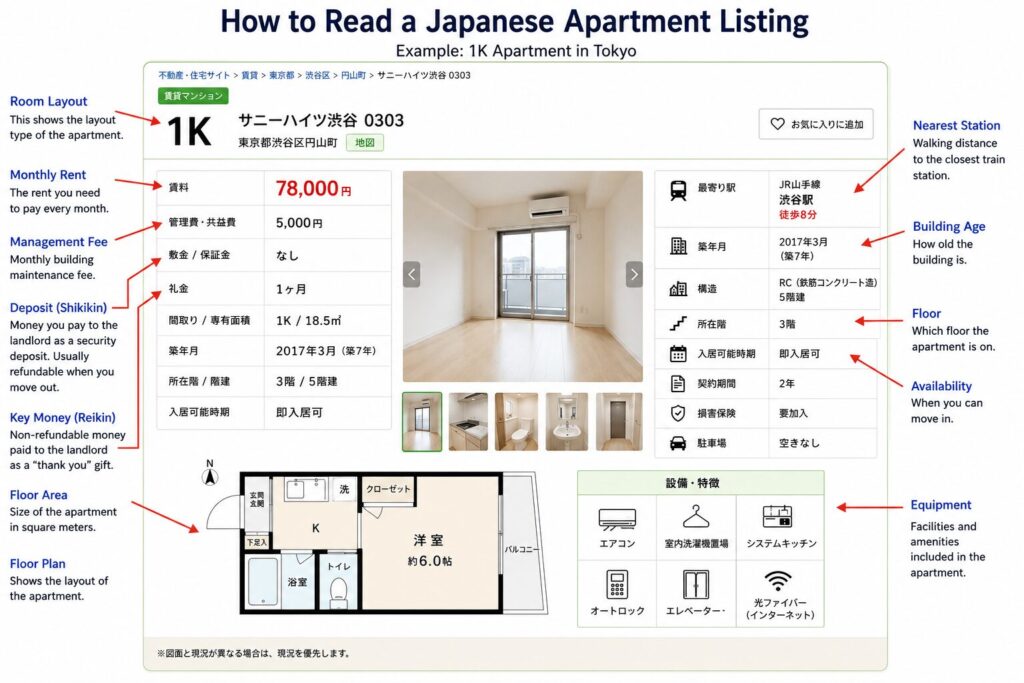
A Real Listing, Annotated
FAQ
Q: Is 1LDK always bigger than 1DK?
A: Generally yes — 1LDK implies a genuinely separate living room in addition to the dining/kitchen area, so it’s typically larger than a 1DK. Always check the stated square meters (㎡) to confirm, since exact sizing can vary between listings.
Q: What does “2階以上” mean in a listing?
A: It means the unit is on the 2nd floor or higher — a preference some renters filter for, often related to security or natural light rather than any formal requirement.
Q: Should I trust the stated walking time to the station?
A: Use it as a rough estimate rather than an exact figure, since it’s calculated using a standard formula that doesn’t account for hills, traffic lights, or your own walking pace.
Your Apartment Listing Reading Checklist
- Confirmed the room layout code (1K/1DK/1LDK etc.) matches your actual space needs
- Compared the jō (畳/帖) size of the main room against your household size before assuming it will feel comfortable
- Checked the exact square meters (㎡), not just the layout code
- Noted whether gas is city gas or propane, and factored this into your budget comparison
- Treated the stated walking time as an estimate and, where possible, walked the route yourself
- Checked whether management fees (管理費) are included in the advertised rent or listed separately
Want More Tips on Finding a Home in Japan?
Knowing how to read a listing is just the first step!
Check out our full collection of guides on room hunting, initial costs, contract processes, and living in Japan as an international student.
👉 Explore All Housing Guides & Articles
Stay Updated with ILSA Hub
Life in Japan comes with a lot of small questions — and the official ILSA Hub LINE account is where we help, especially with housing and everyday life.
- 🏠 Our Main Focus: Most of what we share is about housing and daily life in Japan — apartment hunting, contracts, and practical living tips.
- 💬 Ask Us Anything: Send us your questions about our articles, and we’ll help guide you using site-based information.
- ⏰ Never Miss a Deadline: Set an automated reminder right on LINE — just type “set reminder,” tell it what and when, and our system will notify you automatically as the date approaches (like 30 and 7 days before). Handy for things like visa renewals (up to 90 days’ notice) or lease renewal deadlines. Your dates are kept private and never shared outside ILSA Hub.
Scan or Click to Join:
👉 Tap Here to Add ILSA Hub on LINE

Disclaimer: ILSA Hub is an informational platform. We do not act as a licensed real estate agency, financial institution, medical provider, recruitment agency, or emergency service, and do not provide immigration, visa, or legal services. We are not a substitute for advice from a qualified administrative scrivener (行政書士) or attorney. We do not provide legal, medical, financial, or professional advice specific to your situation. Our responses on LINE are based solely on general guidelines provided on our website. For emergencies, always follow official government guidance.