

Written by Keisuke Unno — a graduate of Tokyo University of Foreign Studies (Persian Language).
Married to a non-Japanese partner, and host of the YouTube channel “Tabunka Gurashi 多文化ぐらし,” where he has interviewed dozens of international residents across Japan about their real lives here.
Like many countries, Japan’s rental market has its own unique challenges for newcomers. If you’ve started apartment hunting as a foreign resident, you may notice a moment of hesitation from an agent after mentioning your nationality or come across a listing that specifies “Japanese residents only” (日本人限定). This is a challenge that many foreign residents experience, and it’s well documented in government and industry survey data. This guide walks through where the friction actually comes from, what your practical options are, and how to move through the process with confidence.
Why Rejection Happens: The Real Numbers
A 2016 Ministry of Justice–commissioned survey of foreign residents found that 39.8% had been refused housing specifically because of their nationality, and 26.8% had encountered properties explicitly marked “no foreigners” and given up searching there entirely. A separate survey by the Japan Property Management Association found that 22.0% of foreign tenants reported being turned down for a property they wanted, with 69.7% of those rejections attributed directly to being foreign.
The same research also found that even foreign residents with strong Japanese conversation and reading skills were rejected at a similar rate, suggesting that the barrier often has more to do with landlords’ concerns about potential risks than with communication itself.
| Survey | Key Finding |
|---|---|
| Ministry of Justice (2016) | 39.8% rejected due to nationality; 26.8% encountered explicit “no foreigners” listings |
| Japan Property Management Association | 22.0% rejection rate; 69.7% of rejections cited “being foreign” as the reason |
| Japan Property Management Association (Landlord Survey) | 52.7% of landlords reported having experienced a “trouble” with a foreign tenant in the past |
💡 【IMPORTANT】 There is generally no specific law in Japan that directly prohibits nationality-based refusal in private housing. The Ministry of Land, Infrastructure, Transport and Tourism (MLIT) actively discourages the practice through guidelines and support programs, which is a meaningfully different framework from an enforceable anti-discrimination statute. Understanding this distinction helps set realistic expectations for how to navigate the process.
Real Story: The Hidden Wall in House Hunting
When I first looked for an apartment, I found a place I really loved on listing sites like SUUMO and at home. I even scheduled a visit and toured the room in person, feeling super excited about moving in. But right after the viewing, the agent told me, “Actually, this property doesn’t accept non-Japanese residents.” It was such a disappointing moment because I had already pictured myself living there.
The agent kindly looked for alternative options that accept foreign residents, and while I eventually found a great place, the whole process took much longer than expected. For every single option, the agent had to call the landlord first just to ask, “Is it okay if a foreigner lives here?” This meant far fewer choices and a lot of waiting time.
Luckily, since my spouse is a Japanese national, having a local guarantor wasn’t an issue for us directly. However, I’ve seen international student friends struggle immensely with this. When moving out of university dorms, many of them frantically search for someone to act as their guarantor because most standard Japanese apartments strictly require a Japanese contact.
Key Takeaway: Even if a property is listed online, it might not be available for non-Japanese residents. Be prepared for extra verification time, limited choices, and strict guarantor requirements!

Understanding the Guarantor System
Most Japanese rental contracts require either a personal guarantor (連帯保証人) or a private guarantor company (保証会社). One practical challenge for many foreign residents is that a valid personal guarantor generally needs to be someone who lives in Japan and has sufficient financial capacity — family members living overseas often aren’t a workable option for this reason, since a landlord has limited practical means of pursuing a claim against someone outside the country.
This is one of the main reasons guarantor companies (家賃保証会社) have become the standard solution for both Japanese and foreign renters alike — landlords increasingly prefer them because a company’s financial standing is easier to verify than an individual’s.
Using a Guarantor Company
A guarantor company doesn’t remove your financial responsibility — it replaces the need for a person willing to vouch for you. You pay a fee, and the company agrees to cover your rent if you default, along with (depending on the company) certain repair or restoration costs.
| Item | Typical Cost |
|---|---|
| Initial guarantee fee (at contract signing) | 50%–100% of one month’s rent |
| Annual renewal fee | ¥10,000/year, or 10%–30% of monthly rent/year |
| Required documents | ID, proof of income (pay slips or tax withholding statement), application form |
Since 2017, the Ministry of Land, Infrastructure, Transport and Tourism (MLIT) has operated an official registration system for rent guarantee companies (家賃債務保証業者登録制度), publishing a list of companies that meet baseline standards. If you’re offered a guarantor company by your agent, checking whether it appears on this registered list is a reasonable trust signal.
💡 【IMPORTANT】 If you’re arranging housing without an agency that specializes in foreign tenants, it can help to specifically ask for a guarantor company with multilingual support (English, Chinese, Korean, or Vietnamese, depending on your needs). Several established companies offer this, which can help the process go smoothly for everyone involved.
Japan’s Housing Safety Net System
Japan has a dedicated legal framework called the Housing Safety Net Act (住宅セーフティネット法, formally 住宅確保要配慮者に対する賃貸住宅の供給の促進に関する法律), which names foreign residents as one of several designated categories of people the system aims to support in securing housing, alongside the elderly, low-income households, single-parent families, and LGBTQ individuals.
Under this system, landlords can voluntarily register their properties as “Safety Net Housing” (セーフティネット住宅). These properties are intended to make housing more accessible for designated groups, including foreign residents, and local governments and MLIT jointly provide subsidies to participating landlords to help make this more financially workable.
💡 【THINGS TO KNOW】 Availability varies significantly by municipality, and registering as Safety Net Housing doesn’t function as an absolute guarantee of acceptance in every individual case. It’s a genuinely useful option to check, particularly in areas where a dedicated local 居住支援法人 (residential support organization) is active.
You can search for your city or ward name together with “セーフティネット住宅,” or contact your local municipal housing counter (住宅課) to find out what options are available in your area.
Multilingual Resources That Actually Exist
The Japan Property Management Association, working with MLIT, has published two resources worth knowing about:
- 外国人の民間賃貸住宅入居円滑化ガイドライン (“Guidelines for Facilitating Foreign Residents’ Access to Private Rental Housing”) — aimed at landlords and agents, outlining considerations around accepting foreign tenants
- 部屋探しのガイドブック (6ヶ国語版) — an apartment-hunting guidebook available in six languages, walking foreign renters through the Japanese rental process step by step
Reading these resources before speaking with an agent can help you better understand the process and communicate more confidently.
Step-by-Step: The Apartment-Hunting Process
- Set your budget including non-rent costs (see the cost breakdown table below) — many first-time renters budget only for monthly rent and are surprised by move-in costs
- Choose an agency — ideally one with experience working with foreign-resident tenants
- View properties — bring your Residence Card, as agents will often ask to see it early in the process
- Submit an application (申込) — this typically requires your Residence Card, proof of income or employment, and emergency contact information
- Guarantor company screening — usually completed within a few days
- Sign the lease and pay move-in costs — confirm the total amount in writing before this step
- Receive your keys and utility setup instructions

The Real Cost of Moving In: A Full Breakdown
Japanese rental contracts bundle several one-time fees that often add up to 4–6 months of rent upfront. Understanding each one ahead of time makes the process much smoother.
| Cost Item | Typical Amount | What It’s For |
|---|---|---|
| Deposit (敷金) | 1–2 months’ rent | Refundable security deposit against damage/unpaid rent |
| Key Money (礼金) | 0–2 months’ rent | A traditional, non-refundable payment to the landlord — a long-standing custom rather than a service fee |
| Agency Fee (仲介手数料) | Up to 1 month’s rent + tax | Paid to the real estate agent for arranging the contract |
| Guarantor Company Fee | 50%–100% of 1 month’s rent | Initial screening and guarantee fee |
| Fire Insurance (火災保険) | ¥15,000–¥20,000/2 years | Often required, arranged through the agency |
| First Month’s Rent | 1 month’s rent | Usually paid in advance, sometimes prorated |
💡 【IMPORTANT REMINDER】 Key money (礼金) is a distinct payment from the deposit and is not refunded, regardless of the condition you leave the apartment in. Confirming this distinction clearly before signing helps avoid confusion at move-out time.
Common Questions vs. Things Worth Double-Checking
Some questions from a landlord or agent are standard practice applied to all applicants; others are worth clarifying so you know exactly where you stand.
| Standard Practice | Worth Double-Checking |
|---|---|
| Asking for proof of stable income or employment | Whether a specific listing is genuinely open to foreign applicants before scheduling a viewing |
| Requiring a guarantor company for anyone without a personal guarantor | Whether any feedback is available if an application is declined (this isn’t always offered to any applicant, Japanese or foreign) |
| Asking about your intended length of stay | Whether a listing has any conditions specific to foreign residents that weren’t mentioned upfront |
| Requesting your Residence Card for ID verification | — |
What They Ask During Room Viewing & How Screening Works
During the property viewing and consultation, the agent checked a few key background details with me. They specifically asked about my relationship status—clarifying that I was married to a Japanese citizen—and gauged my Japanese language proficiency to see whether I could converse basic daily Japanese or not. However, they didn’t dive deep into my job details, workplace contacts, or visa expiration date, likely because my status as a spouse of a Japanese national already provided a sense of stability.
Once we applied, the background screening (shinsa) took about one full week before we got the final approval.
What You Should Know: Questions during viewings vary greatly depending on your visa type. While spouse visa holders might face fewer questions regarding work or visa duration, students and work visa holders are typically asked for proof of income, workplace contacts, and Japanese speaking ability. Always budget at least 1–2 weeks for the screening process to finish smoothly!
A Real Apartment Search, Start to Finish
My Timeline & The Truth About Initial Costs
Here is the exact timeline and budget breakdown from my own apartment search in Japan:
- Properties Viewed: 4 to 5 apartments in person.
- Overall Timeline: About 1 month of browsing online, followed by 1 month from visiting the agency to signing the contract and receiving the keys. Since the room was already vacant, the process moved relatively fast once approved.
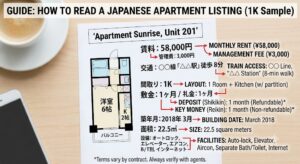
- Security Deposit & Key Money: 1 month’s rent for the Security Deposit (Shikikin), and 0 for Key Money (Reikin).
- Lock Replacement Fee: Around 10,000 to 20,000 JPY due to the high-security dimple key system.
⚠️ Critical Tip: Watch Out for Optional Fees!
During the estimate phase, real estate agencies often push extra non-mandatory services, such as “Pest Extermination Fee” (Gaichu Kujo), “Deodorizing Treatment” (Shoshu), or “Photocatalyst Coating.”
In my case, I firmly declined these optional services. Interestingly, when I refused the pest control fee, the agency ended up offering to do it for free! Many of these added services are completely optional, not legally required. Unless you really want them, feel free to say no and save your money.
Copy-Paste Template: Asking an Agent About Foreign-Resident Policy
📱 1. For Reading & Understanding
お世話(せわ)になります。[Your Name] と申(もう)します。 貴社(きしゃ)が掲載(けいさい)されている部屋(へや)に興味(きょうみ)があります。 外国籍(がいこくせき)ですが、審査(しんさ)は可能(かのう)でしょうか。
📋 2. Copy & Paste Here!
お世話になります。[Your Name] と申します。
現在は [Your Occupation from the table below] をしております。貴社が掲載されている以下の物件に大変興味があり、ご連絡いたしました。
物件URL:[Insert Property URL]大変恐縮ですが、こちらの物件は外国籍の入居相談(お申込み)が可能でしょうか。
ご確認のほど、よろしくお願いいたします。
| Your Situation (English) | Japanese to Use | Romaji | What you’ll need later for screening |
| Student | 留学生 | Ryugakusei | Student ID or Acceptance Letter (Nyugaku kyokasho) |
| Company Employee | 会社員 | Kaishain | Health Insurance Card or Payslip (Kyuyo meisai) |
| Job Offer / Starting Soon | 内定者 | Naiteisha | Job Offer Letter (Naitei-sho) |
| Unemployed | 求職中 | Kyushokuchu | Proof of Bank Balance (Zandaka shomei) |
⚠️Note: You only need to state your status (e.g., “Ryugakusei” or “Kaishain”) in your first message. Do NOT send personal documents or detailed financial info until you decide to apply for a specific apartment.
Finding an apartment in Japan can feel challenging at first, but many foreign residents successfully secure housing every year. Understanding how the system works, preparing the right documents, and working with a real estate agency experienced in assisting foreign residents can make the process much smoother.
FAQ
Q: Is refusing to rent to someone based on nationality illegal in Japan? A: There is generally no national law that explicitly prohibits nationality-based rental refusal in the private market. MLIT actively discourages the practice through guidelines and the Housing Safety Net Act, which function more as a policy and incentive framework than as an enforceable prohibition with penalties.
Q: Do I need a Japanese guarantor if I use a guarantor company? A: In most cases, no — a guarantor company (保証会社) is specifically designed to replace the need for a personal guarantor. Some landlords still request both, so it’s worth confirming this with your agent before applying.
Q: What is Safety Net Housing, and how do I find it? A: It’s a category of rental housing where landlords have voluntarily registered to make housing more accessible to designated groups, including foreign residents. It’s intended to expand access rather than function as an absolute guarantee of acceptance. Search your municipality’s name plus “セーフティネット住宅,” or ask your local housing counter (住宅課) directly.
Q: Is key money (礼金) ever refundable? A: No. Unlike the deposit (敷金), key money is a one-time, non-refundable payment by custom, unrelated to your move-out condition.
Your Foreigner-Friendly Housing Checklist
- [ ] Budgeted for total move-in costs (4–6 months’ rent), not just monthly rent
- [ ] Confirmed whether the property or agency has experience with foreign tenants
- [ ] Asked whether a multilingual guarantor company is available
- [ ] Checked whether your city has registered Safety Net Housing (セーフティネット住宅) as an option
- [ ] Clarified which move-in fees are refundable (deposit) versus non-refundable (key money)
- [ ] Got the total move-in cost confirmed in writing before signing
👉 Explore All Housing Guides & Articles
Stay Updated with ILSA Hub
Life in Japan comes with a lot of small questions — and the official ILSA Hub LINE account is where we help, especially with housing and everyday life.
- 🏠 Our Main Focus: Most of what we share is about housing and daily life in Japan — apartment hunting, contracts, and practical living tips.
- 💬 Ask Us Anything: Send us your questions about our articles, and we’ll help guide you using site-based information.
- ⏰ Never Miss a Deadline: Set an automated reminder right on LINE — just type “set reminder,” tell it what and when, and our system will notify you automatically as the date approaches (like 30 and 7 days before). Handy for things like visa renewals (up to 90 days’ notice) or lease renewal deadlines. Your dates are kept private and never shared outside ILSA Hub.
Scan or Click to Join:
👉 Tap Here to Add ILSA Hub on LINE

Disclaimer: ILSA Hub is an informational platform. We do not act as a licensed real estate agency, financial institution, medical provider, recruitment agency, or emergency service, and do not provide immigration, visa, or legal services. We are not a substitute for advice from a qualified administrative scrivener (行政書士) or attorney. We do not provide legal, medical, financial, or professional advice specific to your situation. Our responses on LINE are based solely on general guidelines provided on our website. For emergencies, always follow official government guidance.