

Written by Keisuke Unno — a graduate of Tokyo University of Foreign Studies (Persian Language).
Married to a non-Japanese partner, and host of the YouTube channel “Tabunka Gurashi 多文化ぐらし,” where he has interviewed dozens of international residents across Japan about their real lives here.
The monthly rent on a Japanese apartment listing is almost never what you’ll actually pay to move in. Between the deposit, the non-refundable “key money,” agency fees, guarantor costs, and insurance, most first-time renters in Japan end up needing 4 to 6 months of rent upfront — and if nobody explains which of these fees come back to you and which don’t, it’s easy to feel like you’re being quietly overcharged.
These costs are real, standardized, and in most cases backed by specific government guidelines and court rulings that define what a landlord can and generally cannot charge you. This guide breaks down every term you’ll see on a Japanese lease, in plain English, along with the general legal framework around them.
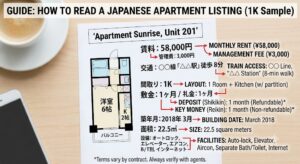
What Are You Actually Paying For? A Quick Glossary
Before the deep dive, here’s the fast version of every term you’ll encounter on a Japanese lease.
| Term | English | Refundable? |
|---|---|---|
| 敷金 (Shiki-kin) | Security deposit | Partially, depending on move-out condition |
| 礼金 (Rei-kin) | Key money | Generally no |
| 更新料 (Koushin-ryo) | Lease renewal fee | No |
| 仲介手数料 (Chukai Tesuryo) | Agency commission | No |
| 保証料 (Hoshou-ryo) | Guarantor company fee | No |
| 敷引き (Shikibiki) | Deposit deduction clause (regional custom) | Partially — a fixed portion is deducted regardless of damage |
Shiki-kin (敷金): The Deposit You’re Meant to Get Back
Shiki-kin functions similarly to a security deposit elsewhere in the world: it’s collected upfront (typically 1–2 months’ rent) and held against unpaid rent or damage beyond normal wear. In principle, whatever remains after legitimate deductions is returned to you when you move out.
The critical phrase is “legitimate deductions” — and this is where most disputes happen. Japan’s Ministry of Land, Infrastructure, Transport and Tourism (MLIT) publishes guidelines specifically aimed at clarifying what a landlord can and cannot generally deduct from your shiki-kin.
⚠️ Keep in Mind: Under MLIT’s Guidelines on Disputes Concerning Restoration to Original Condition (原状回復をめぐるトラブルとガイドライン), ordinary wear and tear from daily living, and natural deterioration over time (経年変化), are generally considered the landlord’s financial responsibility rather than the tenant’s, since this kind of gradual depreciation is considered already factored into the rent you pay every month. Damage caused by negligence, deliberate action, or use beyond what’s considered “normal” is generally the tenant’s responsibility instead.
Rei-kin (礼金): The Payment That Doesn’t Come Back
Rei-kin, literally “gratitude money,” is a cultural holdover from the postwar rental market — a one-time payment to the landlord as a gesture of thanks for the lease, historically without any specific service attached to it. It typically ranges from 0 to 2 months’ rent, and unlike shiki-kin, it is generally not returned, regardless of how well you maintain the apartment.
⚠️ Important Reminder: Rei-kin is sometimes confused with shiki-kin by first-time renters signing quickly through a translated summary. Always confirm on the contract which portion is labeled 敷金 (generally refundable in part) versus 礼金 (generally not refundable) before signing.
A regional variation worth knowing about is 敷引き (shikibiki), common in the Kansai region, where a fixed portion of the deposit is contractually deducted regardless of the apartment’s condition at move-out. Japan’s Supreme Court addressed this practice in two rulings on March 24, 2011 and July 12, 2011, generally upholding shikibiki clauses as valid as long as the deducted amount isn’t excessive relative to the rent and other upfront payments involved.

Renewal Fees (更新料): Generally Valid, But With Limits
Many two-year leases include a renewal fee due at each contract renewal — commonly one to two months’ rent. This has been contested in court in the past as a potential violation of Japan’s Consumer Contract Act (消費者契約法), Article 10, which can void contract clauses that unfairly disadvantage the consumer.
On July 15, 2011, Japan’s Supreme Court addressed this question directly, generally treating renewal fee clauses as valid, reasoning that a renewal fee can have a legitimate economic function — serving in part as supplementary rent and as consideration for continuing the lease — provided certain conditions are met.
| Condition for Validity | What It Generally Means |
|---|---|
| Clearly and specifically stated in the contract | The amount and timing should be explicit — not vague or implied |
| Not excessively high relative to rent | Renewal fees in the rough range of 1–2 months’ rent per renewal have generally been found acceptable in past cases |
⚠️ Keep in Mind: There isn’t one universal cap in yen — it’s generally treated as a relative standard tied to your rent amount and the renewal period. Renewal fees noticeably higher than the 1–2 months’ rent range have a stronger case for being challenged, though each situation is evaluated individually and this isn’t legal advice.
Guarantors and Guarantor Companies
Nearly every standard lease in Japan requires either a personal guarantor (連帯保証人) or, far more commonly today, a private guarantor company (保証会社) — a business that agrees to cover your rent obligations for a fee, replacing the need for a person to vouch for you personally.
| Item | Typical Cost |
|---|---|
| Initial guarantee fee | Often 50%–100% of one month’s rent |
| Annual renewal fee | Often around ¥10,000/year, or roughly 10%–30% of monthly rent/year, depending on the company |
Since 2017, MLIT has operated an official registration system for rent guarantee companies (家賃債務保証業者登録制度), publishing a list of companies meeting baseline standards — worth checking if you want an extra layer of confidence in the company your agent proposes.
The Move-Out Rulebook: MLIT’s Restoration Guidelines
This is one of the most useful documents almost no foreign renter has ever heard of. MLIT’s Guidelines on Disputes Concerning Restoration to Original Condition (原状回復をめぐるトラブルとガイドライン), first published in 1998 and periodically updated since, outlines which categories of wear and damage are generally the landlord’s responsibility versus the tenant’s.
The general principle, reinforced by a Supreme Court ruling on December 16, 2005, is this: absent a clearly-agreed special contract clause stating otherwise, ordinary wear and tear and natural deterioration from the simple passage of time is generally not billed to the tenant — because the cost of that gradual depreciation is considered already built into the rent.
| Category | Generally Whose Responsibility | Examples |
|---|---|---|
| Normal wear (通常損耗) | Landlord | Sun-fading of wallpaper, minor carpet wear from daily furniture placement |
| Natural deterioration (経年変化) | Landlord | Aging of fixtures simply due to time passing |
| Tenant negligence/damage (賃借人の故意・過失) | Tenant | Cigarette burns, unrepaired pet damage, mold from neglecting ventilation |
The guidelines also generally apply depreciation schedules to items like wallpaper, meaning a tenant’s financial responsibility for a damaged wall can shrink the longer they’ve lived there, since older finishes are considered to have already used up much of their expected lifespan.
This distinction isn’t just theoretical — I’ve personally pushed back on a move-out charge that was raised only after the in-person walkthrough had already ended, rather than being pointed out on the spot, and ultimately didn’t pay it. More on exactly how that played out later in this guide.
⚠️ Important Reminder: If you’d like a reference for these restoration guidelines, ask your agent whether a multilingual summary is available, or check MLIT’s website directly.
Full Initial Cost Breakdown
| Cost Item | Typical Amount | Refundable? |
|---|---|---|
| Deposit (敷金) | Often 1–2 months’ rent | Partially, per move-out condition |
| Key Money (礼金) | Often 0–2 months’ rent | No |
| Agency Fee (仲介手数料) | Up to around 1 month’s rent + tax | No |
| Guarantor Company Fee | Often 50%–100% of 1 month’s rent | No |
| Fire Insurance | Often around ¥15,000–¥20,000 per 2 years | No |
| First Month’s Rent | 1 month’s rent | N/A (advance payment) |
Optional Add-On Fees Sometimes Offered During Signing
Beyond the standard items above, it’s common for an agent to present a few extra line items while you’re signing — things like key replacement, an antibacterial/deodorizing coating, or pest control. These aren’t always clearly labeled as optional, so it’s worth understanding what each one generally is before deciding whether you want it.
| Item | What It Generally Is | Typically Optional? |
|---|---|---|
| Key exchange fee (鍵交換費用) | Replacing the lock/key so a previous tenant’s key no longer works. Often ¥15,000–¥35,000 depending on the lock type | Often treated as close to standard practice in many contracts, though MLIT guidance generally leans toward this being a property-management cost rather than something automatically billed to an incoming tenant — worth asking about before signing |
| Photocatalyst / antibacterial-deodorizing coating (光触媒・消臭抗菌施工) | A coating marketed as reducing odors, bacteria, or allergens in the unit | Generally optional and not covered by any government guideline — often possible to decline |
| Pest control / disinfection (害虫駆除・消毒代) | A preventive treatment applied before move-in | Generally optional and not covered by any government guideline — often possible to decline |
| 24-hour support service (安心サポート等) | A packaged service for emergency repairs or trouble response, sometimes overlapping with things your fire insurance or guarantor company already covers | Generally optional — worth checking whether it duplicates coverage you already have elsewhere |
⚠️ Keep in Mind: The general pattern across these add-ons is that they’re easier to question or decline before you sign than after. Once the contract is signed, pushing back on a fee you already agreed to becomes much harder. If you’re unsure whether something is mandatory or optional, it’s reasonable to simply ask directly — and to ask in writing or keep a record of the answer.
Things to Watch For at Move-Out
| Generally Reasonable Charge | Worth Questioning |
|---|---|
| Repair costs for a hole you drilled into the wall | A bill for “general cleaning” with no itemized breakdown |
| Replacing a carpet you visibly damaged with a spill | Full replacement cost for wallpaper installed many years ago |
| Charges specifically itemized against your move-in checklist | A flat “restoration fee” with no reference to the actual condition |

A Real Deposit Settlement: What Happened When I Moved Out
When it came to the move-out settlement, someone from the real estate company came to the apartment in person to check its condition. During that walkthrough, they pointed out that the wallpaper had deteriorated and charged a wallpaper replacement fee, and also noted that the kitchen had some rust buildup, which came with a separate charge for professional rust removal.
What caught me off guard was what happened afterward: I later received a message saying they’d found additional stains that supposedly couldn’t be cleaned, along with another charge for that. I pushed back specifically on that charge, since it was never raised during the actual in-person walkthrough — if it was serious enough to bill for, it should have come up right there while we were both standing in the apartment looking at it together. In the end, I didn’t pay that particular fee.
One thing I’d genuinely recommend from this experience: record audio (with the other person’s knowledge) during your move-out walkthrough. Having your own record of exactly what was pointed out — and what wasn’t — makes it much easier to push back if a new charge shows up afterward that wasn’t part of the original conversation.
Copy-Paste Template: Requesting an Itemized Move-Out Bill
If a move-out bill feels vague or unclear, these polite Japanese phrases can help you ask for more detail without sounding confrontational:
To request an itemized breakdown referencing MLIT’s guidelines:
「原状回復費用の内訳について、国土交通省のガイドラインに基づいた明細書をいただくことは可能でしょうか?」
(Could I get an itemized breakdown of the restoration costs, based on the MLIT guidelines?)
To ask which charges are normal wear vs. other damage:
「恐れ入りますが、通常損耗・経年劣化に該当する箇所と、それ以外の箇所を分けて教えていただけますでしょうか?」
(I’m sorry to trouble you, but could you separate which parts are considered normal wear/aging versus other damage?)
To question a charge raised after the walkthrough:
「立会いの際にご指摘いただいていなかった項目について、追加でご説明いただけますでしょうか?」
(Regarding items that weren’t pointed out during the walkthrough, could you give me additional explanation?)
To buy yourself time before agreeing to a charge:
「この金額について、一度持ち帰って検討させていただいてもよろしいでしょうか?」
(Would it be all right if I took some time to consider this amount?)
FAQ
Q: Can I ever get my rei-kin back?
A: Generally no — unlike shiki-kin, rei-kin is a one-time, non-refundable payment by long-standing custom, unconnected to your move-out condition.
Q: Are renewal fees legally required?
A: Only if your contract specifically and clearly states one. Courts have generally upheld renewal fee clauses as valid, provided they’re explicitly written into the contract and not excessively high relative to your rent.
Q: Can my landlord charge me for repainting the whole apartment when I move out?
A: Generally not the full cost, if the wear is from ordinary living and the finish is well past its typical useful life — this is generally treated as the landlord’s cost under MLIT’s guidelines. You can generally still be billed for specific damage you caused beyond normal wear. This isn’t legal advice; specific disputes should be discussed with a qualified professional.
Q: Is a guarantor company mandatory?
A: In most modern leases, yes, unless you have a qualifying personal guarantor. It has become the default path for both Japanese and foreign tenants alike.
Your Initial Costs Checklist
- Confirmed which fees are labeled 敷金 (generally refundable in part) versus 礼金 (generally non-refundable) before signing
- Asked whether a shikibiki-style deduction clause applies in your region
- Confirmed the exact renewal fee amount and renewal interval in writing
- Verified your guarantor company appears on MLIT’s registered company list
- Took time-stamped photos of the apartment’s condition at move-in
- Considered recording audio (with the other party’s knowledge) during the move-out walkthrough
- Kept a copy of MLIT’s restoration guidelines summary for reference at move-out
👉 Explore All Housing Guides & Articles
Stay Updated with ILSA Hub
Life in Japan comes with a lot of small questions — and the official ILSA Hub LINE account is where we help, especially with housing and everyday life.
- 🏠 Our Main Focus: Most of what we share is about housing and daily life in Japan — apartment hunting, contracts, and practical living tips.
- 💬 Ask Us Anything: Send us your questions about our articles, and we’ll help guide you using site-based information.
- ⏰ Never Miss a Deadline: Set an automated reminder right on LINE — just type “set reminder,” tell it what and when, and our system will notify you automatically as the date approaches (like 30 and 7 days before). Handy for things like visa renewals (up to 90 days’ notice) or lease renewal deadlines. Your dates are kept private and never shared outside ILSA Hub.
Scan or Click to Join:
👉 Tap Here to Add ILSA Hub on LINE

Disclaimer: ILSA Hub is an informational platform. We do not act as a licensed real estate agency, financial institution, medical provider, recruitment agency, or emergency service, and do not provide immigration, visa, or legal services. We are not a substitute for advice from a qualified administrative scrivener (行政書士) or attorney. We do not provide legal, medical, financial, or professional advice specific to your situation. Our responses on LINE are based solely on general guidelines provided on our website. For emergencies, always follow official government guidance.