

Written by Keisuke Unno — a graduate of Tokyo University of Foreign Studies (Persian Language).
Married to a non-Japanese partner, and host of the YouTube channel “Tabunka Gurashi 多文化ぐらし,” where he has interviewed dozens of international residents across Japan about their real lives here.
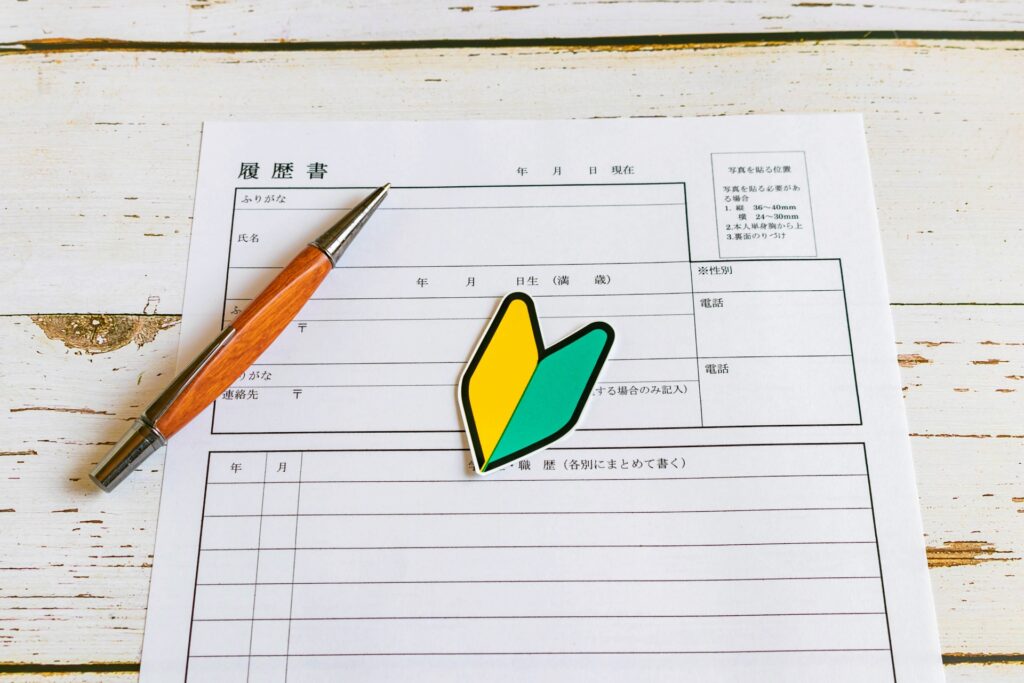
The rirekisho (履歴書) is one of Japan’s most widely used résumé formats, and while it might feel rigid compared to résumé styles you’re used to, understanding its structure makes it much easier to fill out well. It’s worth knowing upfront that exact requirements vary by company and industry — some employers request it, some don’t, and formats aren’t perfectly uniform across every template in circulation.
Short answer: it’s a largely standardized document covering your personal details, education and work history in chronological order, qualifications, and your motivation for applying — commonly submitted alongside a separate, more detailed shokumu-keirekisho (職務経歴書) for professional roles.
Rirekisho vs Shokumu-keirekisho: What’s the Difference?
| 履歴書 (Rirekisho) | 職務経歴書 (Shokumu-keirekisho) | |
|---|---|---|
| Format | Fixed, standardized template | Free-form, generally 1-2 pages |
| Content | Personal details, education/work history in list form, qualifications | Detailed narrative of your work experience, achievements, and skills |
| When it’s needed | Widely used and commonly requested, though not universal across every company or industry | Commonly expected for mid-career and professional roles; less common for entry-level or part-time positions |

The 2021 Format Update You Should Know About
If you’re starting from scratch today, using the current Ministry of Health, Labour and Welfare (MHLW) sample template is generally a safe default unless your employer specifies a different format. Here’s the background on why two versions exist.
Until 2020, the de facto standard in Japan was based on a format published as part of a Japanese Industrial Standards (JIS) reference document. In July 2020, following advocacy from LGBT rights organizations specifically calling for the removal of a mandatory gender field, the Japan Standards Association removed the resume format from its official JIS reference materials entirely. MHLW subsequently published its own sample resume template (履歴書様式例) in April 2021, intended as a reference for employers and job seekers pursuing fair hiring practices.
| Field | Old JIS-Style Format | MHLW Sample Template (2021–) |
|---|---|---|
| Gender (性別) | Typically required | Optional — can be left blank entirely |
| Commute Time (通勤時間) | Typically included | Not included |
| Spouse (配偶者) | Typically included | Not included |
| Dependents (扶養家族数) | Typically included | Not included |
⚠️ Keep in Mind: Some employers may still ask applicants to complete fields like gender or family status when using their own company-specific template, even though the current MHLW sample template omits them entirely.
Section-by-Section Breakdown
1. Basic Information (基本情報)
- Date of writing — many templates expect this updated to the date you actually submit it, not when you first drafted it
- Name, date of birth, address, contact information — straightforward, though address formatting follows Japanese conventions (postal code, prefecture, city, etc.)
- Photo — a formal photo is commonly expected in the designated box; conventions around attire and background are generally recommended rather than strictly mandated, though following common practice (plain background, business attire) is a safe default
| Aspect | General Convention |
|---|---|
| Size | 30mm × 40mm (or 40mm × 30mm depending on the template) |
| Background | Plain, light-colored (white, light blue, or light gray) |
| Expression | A natural, neutral expression is generally recommended |
| Attire | Business attire is generally recommended, though this varies by industry |
| Recency | Taken within the last 3 months |
2. Education and Work History (学歴・職歴)
Listed in chronological order, generally starting with your most senior secondary or post-secondary education, through to your most recent job. Japanese convention typically separates 学歴 (education) and 職歴 (work history) into their own labeled sections within the same chronological table, with the word 「以上」 (literally “the above/that’s all”) written on its own line directly after the very last entry in the entire history section — marking the end of the list, not a header for each entry.
💡 If you attended school or worked outside Japan, it’s generally fine to include the institution or company name in its original language alongside an English or Japanese translation for clarity, since the reviewer may not be familiar with a foreign institution’s name.
3. Qualifications and Licenses (資格・免許)
List relevant certifications, language proficiency test results (like JLPT level, if applicable), and any professional licenses. If you don’t have formal certifications relevant to the role, it’s generally acceptable to note relevant skills here instead, though the section is traditionally intended for formal qualifications.
4. Motivation for Applying (志望動機)
This section asks why you specifically want this job at this company — generic answers are generally noticeable to reviewers, so connecting your specific background or interests to the company’s actual work tends to stand out more than a broadly reusable answer.
5. Personal Preferences / Requests (本人希望記入欄)
A space to note any specific requests, such as preferred work location if the company has multiple offices, or other relevant conditions. If you don’t have specific requests, writing something like 「貴社規定に従います」(I will follow your company’s policies) is a commonly used, neutral phrase.
Common Kanji You’ll See on Every Rirekisho
| Japanese | Meaning |
|---|---|
| 入学 | Entered school |
| 卒業 | Graduated |
| 入社 | Joined company |
| 退社 | Left company |
| 現在に至る | Present (still ongoing) |
| 以上 | End of list |
Keeping this table nearby while filling out your rirekisho can save a lot of dictionary look-ups.

Formatting Conventions Worth Knowing
| Convention | General Guidance |
|---|---|
| Handwritten vs. digital | Digital rirekisho are commonly accepted today, especially for online applications, though some traditional companies may still prefer handwritten versions — if unsure, a digital version is generally a safe default unless specified otherwise |
| Photo style | Generally recommended: plain background, business attire, neutral expression — not a strict legal requirement, but a widely followed convention |
| Hanko (personal seal) | Older traditional formats sometimes include a space for a personal seal, but many current templates in circulation have dropped this field entirely as part of Japan’s broader move away from hanko-based paperwork; if it’s not present or not explicitly requested, this is generally not a concern for foreign applicants |
| Phone number format | Japanese phone number formatting (e.g., 090-XXXX-XXXX) is commonly expected if you have a Japanese number; if you only have a foreign number, including the country code clearly is a reasonable alternative |

Formatting Your Work History as a Foreigner
| Your Original Title | A Clearer Equivalent for a Japanese Reviewer |
|---|---|
| Growth Hacker | Marketing Strategy (マーケティング戦略) |
| Customer Success Manager | Customer Support / Client Relations (カスタマーサポート) |
| Sales Engineer | Technical Sales (技術営業) |
| Evangelist | Product Marketing / Community Lead, depending on actual duties |
Two friends of mine took different paths to their first rirekisho. One handed her English-language resume to a Japanese friend, who reformatted the content into the standard rirekisho layout for her. Another built her own version in Japanese, based loosely on the European-style CV format she was used to from home — a reminder that a reasonably close approximation is often good enough, especially early on.
Writing a Motivation Section That Actually Works
| Weaker Example | Stronger Example |
|---|---|
| “I like Japan and want to work here.” | “I would like to apply my five years of marketing experience to help [Company]’s growing international customer base.” |
| “I am a hard worker and fast learner.” | “In my previous role, I reduced onboarding time for new clients by 30% — a skill I’d like to bring to your team.” |
Common Mistakes Foreign Applicants Make
- Submitting a resume translated word-for-word from a Western CV format instead of using the rirekisho template structure
- Leaving the 志望動機 (motivation) section generic or reused across multiple applications
- Forgetting furigana readings above your name and address
- Omitting 以上 at the end of the work history section
FAQ
Q: Can I write my rirekisho in English?
A: This depends heavily on the company and role — some international or foreign-friendly companies accept English rirekisho, while many domestic Japanese companies generally expect Japanese. When in doubt, ask the recruiter or check the job posting’s language before assuming.
Q: Do I need to include a photo?
A: Most standard rirekisho templates include a designated photo space, and providing one is commonly expected — leaving it blank without explanation may come across as incomplete.
Q: Where can I get a rirekisho template?
A: Templates are widely available for free online (both digital fillable formats and printable ones), and are also sold at convenience stores and stationery shops in physical form.
Your Rirekisho Checklist
- Used a standard, widely recognized rirekisho template rather than an informal format
- Listed education and work history in correct chronological order with consistent date formatting
- Included a business-appropriate photo in the designated space
- Wrote a specific, company-relevant motivation statement rather than a generic one
- Confirmed whether the company expects a rirekisho in Japanese, English, or either
- Prepared a separate shokumu-keirekisho if applying for a professional or mid-career role
Stay Updated with ILSA Hub
Life in Japan comes with a lot of small questions — and the official ILSA Hub LINE account is where we help, especially with housing and everyday life.
- 🏠 Our Main Focus: Most of what we share is about housing and daily life in Japan — apartment hunting, contracts, and practical living tips.
- 💬 Ask Us Anything: Send us your questions about our articles, and we’ll help guide you using site-based information.
- ⏰ Never Miss a Deadline: Set an automated reminder right on LINE — just type “set reminder,” tell it what and when, and our system will notify you automatically as the date approaches (like 30 and 7 days before). Handy for things like visa renewals (up to 90 days’ notice) or lease renewal deadlines. Your dates are kept private and never shared outside ILSA Hub.
Scan or Click to Join:
👉 Tap Here to Add ILSA Hub on LINE

Disclaimer: ILSA Hub is an informational platform. We do not act as a licensed real estate agency, financial institution, medical provider, recruitment agency, or emergency service, and do not provide immigration, visa, or legal services. We are not a substitute for advice from a qualified administrative scrivener (行政書士) or attorney. We do not provide legal, medical, financial, or professional advice specific to your situation. Our responses on LINE are based solely on general guidelines provided on our website. For emergencies, always follow official government guidance.